

Top 5 Injuries for Parents (And How To Fix Them!)
- scottkbisbee

- Apr 29
- 8 min read

Since we are all getting older, raise a hand if you have ever tweaked your back? Had shoulder pain? Are your forearms tight? Are your knees hurting?
If you haven't experienced pain in any of these areas yet, that is great for you!
Most parents don't get hurt in the gym. They get hurt outside of it! Some parents' form of activity is going to the gym two times per week, and on top of their day-to-day office job this could actually spell bad news. Your body needs activity.
That being said, they are getting hurt doing normal parent day stuff like dealing with those pesky car seats, laundry and or groceries.
You could be just tight in the wrong areas, weak in the right ones or moving your body in ways that it isn't ready for.
Here's the thing, though: most of this is fixable.
I will show you how. Let's start with the lower back first.
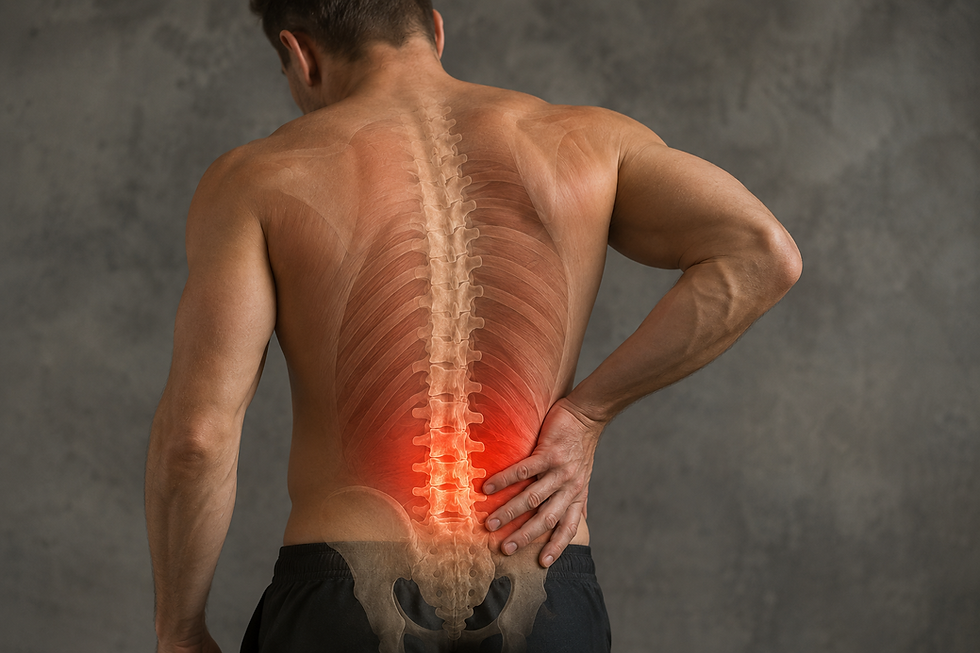
Causes of Low Back Pain
You could be picking up your kids with poor posture or sitting too much, old injuries or a weak core and glutes, just to name a few.
This may feel like sharp pain that makes it hard to walk or dull, achy pain that never seems to go away. You may not be able to sit down, or you may not be able to lie down. Or you may not be able to do both!
Here are some red warning flags that if you are experiencing any of these, don't try to do these exercises and see a doctor right away.
Pain shooting down your leg.
Night Pain. Or Pain when you're resting
Having Trouble going to the bathroom
Trauma associated with certain fractures
Spinal Instability (One or more vertebrae slip forward when the back is in a flexed or extended position)
Lumbar Stenosis (nerve canal narrowing) that results in unremitting pressure on nerves and constant pain.
Tumor or infection that is indicated by back pain, unexplained weight loss and/or fever.
Aneurysm in the abdominal area
Cauda Equina Syndrome - nerve roots in the lumbar region, especially those that control bladder and bowel function, are compressed and paralyzed, cutting off sensation and movement.
The first exercise I'm about to show you is called the Hip Flexor Stretch or Bed Stretch. When your back is angry, do this right away to help calm things down. Just like the name implies, you can do this off the bed.
Hold the stretch for at least two minutes per leg.
Really focus here on flattening your lower back to the bed or box shown here, and bring in that belly button, push down, like a piston, and breathe behind the shield to work the small stabilizer muscles of the spine, to get the best results.
Remember this, as this will be a key component to all back exercises that I'm about to show.
The next few exercises when paired together, are called the McGill Big 3 for Core Stability.
Here's a little bit about the guy who made these exercises famous.
Dr. Stuart McGill is a world-renowned professor who has written over 240 peer- reviewed scientific papers all about causes of back pain and what to do during a painful episode. He is the ultimate G.O.A.T. when it comes to lower back rehab.
The first exercise is called the McGill Sit Up. Place your hand on your lower back as you are lying down on the floor, with one leg bent, and crunch up towards the ceiling. As you do this, you will feel your lower back pressing into your hand and your abdominals working. This is a good thing.
Follow as shown
You will do this exercise after the hip flexor stretch. Do 4-8 reps.
Next up, the side plank.
Hold for 12-15 seconds per side.
Quickly followed by...
The Bird Dog
If you are familiar with this exercise, there is a bit of a twist to it. When you extend both your opposite leg and arm, hold that position for 3-5 seconds. Perform 4-6 reps per side.
Do these 4 exercises 3-5x daily if you are going through a painful back episode, or you can do this as a movement break or warmup.
Causes of Shoulder Pain
Let's talk about shoulder pain now.
Shoulder pain for parents could be caused by poor posture, carrying kids on one side or a weak upper back.
This may feel like pain when reaching overhead, or also a dull ache in your shoulder when you wake up in the morning.
Here are some important red flags you should be aware of before you start working on your shoulder(s), and you may need to see a doctor right away or emergency care.
Shoulder pain combined with any of these symptoms require IMMEDIATE emergency care: chest pressure-tightness or squeezing, shortness of breath, pain radiating to the jaw or left arm, nausea, cold sweats/light headedness, or a feeling of impending doom.
Stroke
Loss of strength in the arm
A pins and needles feeling in the hands.
Shoulder pain progressing to the neck.
Night pain disrupting sleep for more than 2-3 weeks.
Visible deformity or a new bump on the shoulder.
Shoulder pain after a fall or injury
Once again, here are a few exercises to help with your shoulder(s)
First exercise is a great mobility exercise for the shoulders (and hips too!)
Do 2 sets of 5-6 deep breath cycles on each side. I say deep breathing here because breathing properly has been shown to increase shoulder mobility.
Deep breath, inhale through the nose, air going right past your belly button, hold it for 1-2 seconds, then exhale through the mouth. This mobility exercise will go hand in hand with people who suffer from low back pain as well!
The next exercise will help improve posture and strengthen those upper back muscles.
This is called the Strength Band Splitter.
Perform 2 sets of 10-12 reps.
The third exercise is one of my favourites for the back. This is called the TRX Back Row, and this is how it's performed.
Get in a plank position as you would on the ground, except you are standing up, grab the handles and pull. Make your feet closer to the anchor point to make it harder, or walk your feet back so you are in more of an upright position. Squeeze your armpits during the movement to get the most benefit.
Do 2 sets of 8-12 reps.
The last exercise for the shoulders is the Farmers Carry.
Grab a pair of heavy kettlebells or dumbbells and just walk. Have your core engaged throughout the entire time.
2 sets of this should be fine.
Causes of Knee Pain
Knee pain could be caused by all sorts of things, like weak quads or glutes (Hint: if you have a bad back, you may have bad knees too), poor movement patterns, patellar tendinitis, aka "jumper's knee," a meniscus tear or a ligament tear.
For this blog though, we will discuss how to fix the muscle imbalance.
Here are some red flags for knee pain. If you are experiencing any one of these, see your doctor right away.
"Locked" Knee - The knee is literally locked, and you can't move it. This will probably require surgery.
Bloody fluid in the knee - Something is probably torn, and you need surgery.
Cloudy fluid - Could be any sorts of things. Best to see your doctor right away.
That being said, here are a few exercises to help your knee(s) if you aren't experiencing any of the symptoms that I just listed.
The first exercise is the Step Up.
One thing to keep in mind with these leg exercises is to play around with the tempo. Meaning how long it takes you to do one rep of a movement. This will really benefit your muscles especially if you have something like "jumper's knee."
Perform 3 sets of this exercise and do 8-12 reps.
The next exercise is the Leg Press.
Another thing that you can do is play around with the range of motion in an exercise. You can see in this video that I am doing a short range of motion, and if you have knee pain, this will definitely help.
The same principle, playing with the range of motion, can be said with the next exercise that I'm about to show you.
The Leg Extension. With the leg extension, set it up so that you are doing a short range of motion for the exercise, as shown.
Do 2 sets of 14-16 reps
Causes of Elbow Pain
Elbow pain could be caused by too much computer work, weak forearms, and or repetitive stress.
If you have elbow pain, you probably feel pain when you grip, lift or carry.
First, let's look at some warning signs. If you are experiencing one of these symptoms, see a doctor right away.
Persistent pain that won't go away.
Swelling, redness or warmth.
Numbness or tingling in your hand.
Difficulty using your wrist for everyday activities. This could be anything from picking up a coffee mug to carrying groceries.
A popping or grinding sensation in the wrist
Here are some exercises to fix elbow pain. Keep in mind here that you want to keep it light, gradually load the exercises, and reduce overloading.
You also want to play around with the tempo of exercises, as previously discussed. So if you do a dumbbell floor press (which I highly recommend for elbow pain) in the negative portion of the exercise, it should take 4-5 seconds to go back to the starting position instead of the normal tempo.
The first exercise for elbow pain, use a massage ball on the forearm or a massage gun like the video shown. The reason why you want to do this is because this helps break up muscle tissue and provides blood flow.
Do each arm for about 45 seconds.
The next exercise is a stretch. This is called the wrist flexion stretch. Get on your hands and knees. Have your fingers pointed towards your knees and sit back on your heels until you feel the stretch in your forearms.
Hold this position for 2 minutes. Do these two exercises back-to-back for best results. 2 to 3 times daily.
Another great exercise is the dumbbell floor press for two reasons. You are protecting the shoulder, and by lowering the weight slowly you are making the tendon in the forearm stronger which will help reduce symptoms.
Try lowering the weight for a count of 5, like the video shown.
Do 3 sets of 8-10 reps
Causes of Neck Pain
Neck Pain, just like everything else that's listed here, could be caused by poor posture, like being on your phone too much, sitting behind a desk all day or stress.
This can feel like you have tight traps, or you could also have a lot of headaches throughout the day or you may notice that your neck is stiff.
Here are some red flags that you need to be aware of for your neck. Again, if you have any of these symptoms, see a doctor right away.
Radiating pain, numbness or weakness
Pain that doesn't go away
Severe neck pain after an injury
Loss of coordination or balance
Also, develop weakness in legs or problems going to the bathroom.
You have other medical problems, such as, history of a recent accident, cancer or arthritis.
The number one thing that you can do to help with neck pain is awareness. What do you do during the day that is causing neck pain? Do you get up in the morning with a stiff neck? Maybe you need a new pillow? Are you on the phone a lot throughout the day? Maybe you need to adjust how you talk on the phone, or are you behind a desk all day? Try moving around every 20 minutes.
Hopefully, those strategies will work.
Here is a great mobility exercise that you can do too. It's a simple upper body roll but use your head to work your neck like in the video shown.
Try do 5 rolls on each side for the best results.
Other exercises to strengthen the upper back, like the TRX Row previously shown, will help with neck pain as well.
The BIG Picture
Most of these "injuries" aren't injuries. That's good news! They are mostly caused by poor movement patterns, lack of movement, too much sitting, and too little strength.
What parents actually need is, short consistent strength training and movement throughout the day.
10-30 minutes done consistently beats doing nothing because you don't have time.
Final Thought
You don’t need to stop moving.
You need to move better.
Most of the aches and pains parents deal with are fixable — not with rest alone, but with the right kind of movement.
If you're dealing with aches and pains and don't know where to start. I can help you build a plan that actually works. Message me today for more info!


Comments